
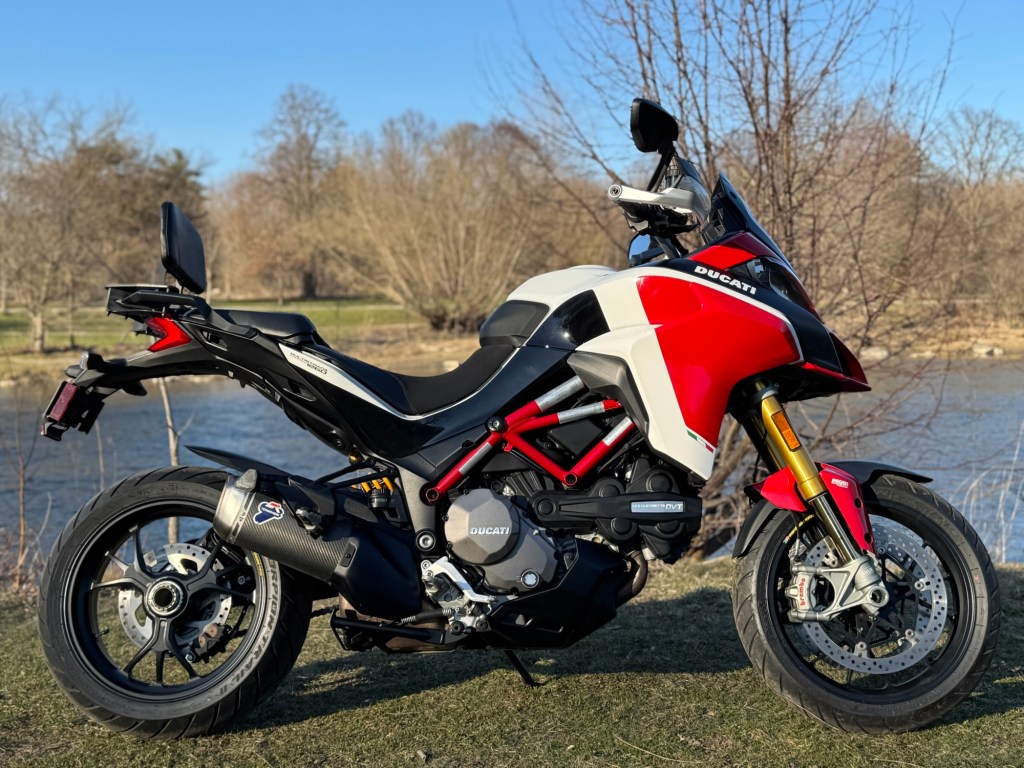
Is newer better? What has Ducati achieved, lost or gained by moving away from its big L-Twin engine configuration and into a new era of V4 powered Multistradas? It’s a battle of old vs new, analog vs digital and tradition vs evolution.
Introduction & History
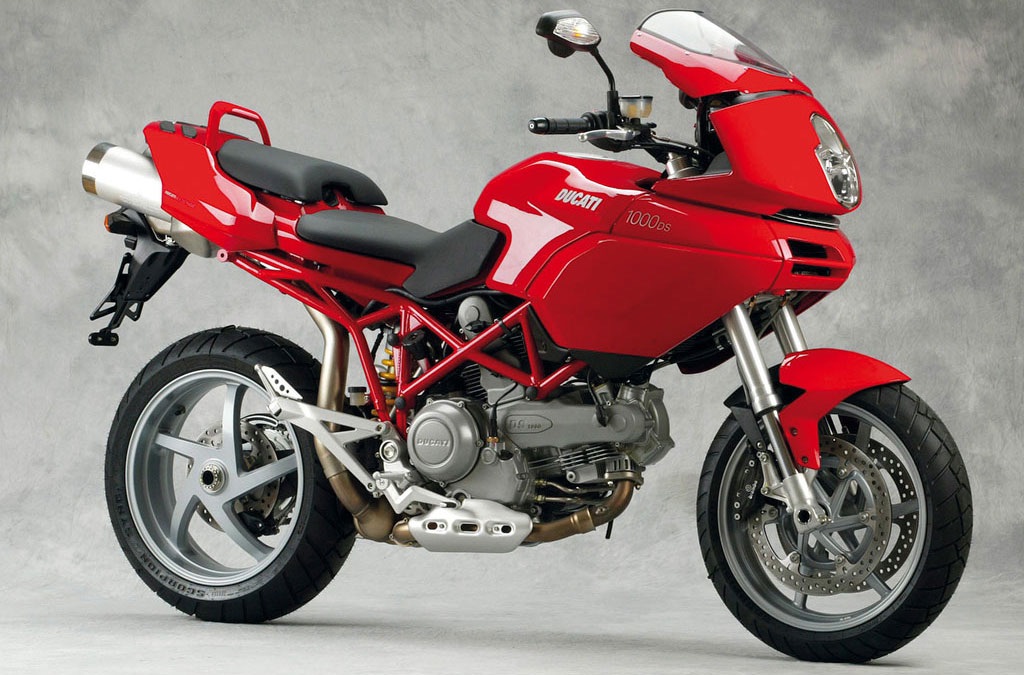
For the uninitiated, Ducati’s Multistrada (which translates from Italian as “multi road”) is a now 22 year old platform that started with the concept of producing the most versatile sport motorcycle possible. For those who weren’t around in the early 00’s, it’s important to remember that Ducati of that era was very much an unapologetic pre-Audi (ownership), race-bread Italian motorcycle brand. So the 2003 Multistrada was launched with much consternation around why and how this tall and (subjectively) goofy looking motorcycle could fit in with the Ducati brand ethos.
It wasn’t long before Multistradae (?) started showing up at track days, and once enough owners got to stretch this new platform’s legs on back road sweepers, it became clear that there was the kernel of something special in what Ducati had produced.
As with all things Motorsport, the multi has evolved significantly over the last 2 decades, gaining horsepower and torque, but also weight, length and technology. Today, the Multi is available as both a heavyweight V4 variant as well as a middleweight V2.

Where does the 1260 DVT Rank?
The 2018-2020 Multistrada DVTs represent the last of the heavyweight V-twin Multistradas -that is, before Ducati introduced its new V4 architecture which powers 2021+ Multis. As such, this last dance V-Twin espouses the very best of what post-Audi Ducati was able to achieve from the platform from an engineering, research and development point-of-view. Compared to its prior 1200cc roots, the bike is a little more powerful, has a little more tech (Ducati Variable valve Timing being at the forefront), sits a heavier and a little longer. The result is a surefooted, flexible and versatile motorcycle that’s mostly gentleman, but still has a hooligan side.
While any variant of the 1260 DVT would make a fantastic do-it-all bike, there is a “choose your own adventure” component to the various trim levels -specifically when talking about the top trim levels (those being the “S” and Pike’s Peak variants). The most significant reasons for the Pikes Peak’s existence are sporty-tire-shod 17” forged wheels and race-spec suspension. Where the Multistrada S prides itself in being well-balanced all-rounder, the Pike’s Peak ignores dirt and gravel in exchange for a lighter, sportier demeanour.
Multistrada 1260 DVT vs V4 Comparison
If you’re reading this, you’re probably aware of the success Ducati has enjoyed from taking its MotoGP-derived V4 power plant and adapting it to everything from the Panigale V4 to the Multistrada V4 family.
While a separate review of the Multistrada V4 is required, what we can tell you about the differences between these 2 bike generations is best summarized in 3 sections:
- Torque
- Suspension & Chassis
- Technology
Torque:

The 1260 DVT motor excels at smooth torque delivery. Its midrange is simply sublime and the fat powerband between 4,000 and 7,000 RPM gives the 1260 Pikes Peak a really flexible, laidback character. The motor is happy to rev but there’s little reward to be found in doing so. All that torque also means you have at least 3 gears available to you at any time and one can lazily prod along 1 or even 2 gears higher than ideal and the motor’s variable valve timing still delivers smooth power. Smooth, for a giant V-Twin.

The V4 Multistradas are a different animal altogether insofar as the motor is concerned. Here, the gobs of low end torque are notably absent but torque quickly builds from around 5,000 RPM to the bike’s 10,000 RPM redline (or 13,000 RPM redline in the case of the Multistrada V4 RS). Do not mistake this V4 for an anemic inline 4 however. The midrange is ample and all but the most sport-focused riders will be satisfied with its power delivery. Again, based on physics, the motor feels much smoother and refined in comparison to the 1260 DVT as the 4 smaller pistons (firing in a “twin pulse” firing order and sounding more like a twin than a V4) transmit more of a “hum” than a “thump” which can barely be felt in the handlebars or footpegs.
Suspension & Chassis
The Pikes Peak 1260 DVT features high spec, fully adjustable (analog) Ohlins suspension front and rear. It provides a very compliant ride and enough adjustment that one could easily do a track day, then back off a little preload and happily ride home. The front end provides great feel when cornering and trail braking, though there’s never any denying you’re riding an overweight superbike on stilts. If you’re pushing the pace on a hill climb, you’ll feel like you’re on a superbike and realize there’s a reason Carlin Dunne (RIP) won the race that gave this bike its name back in 2018. Brakes are superbike spec and aside from a bit of front end dive from the long-travel suspension, provide fantastic feel and modulation.
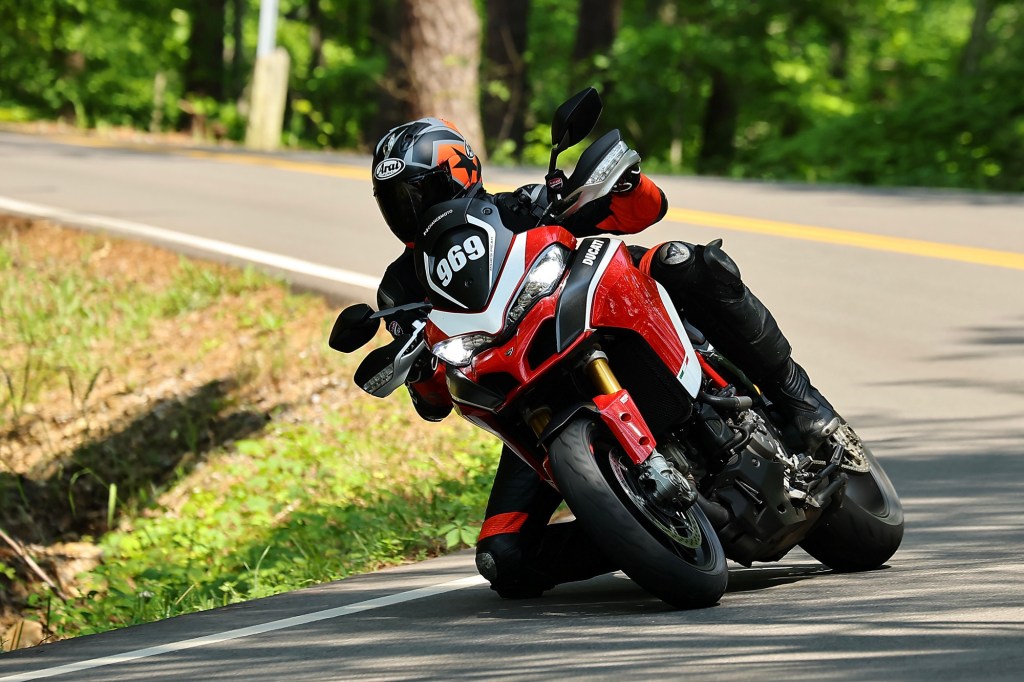
The Multistrada V4 Pike Peak & RS ride on 2nd generation Ohlins Smart EC2 electronic suspension. An event-based system that “dumbs down” suspension setting into laymen’s terms (“Softest, Soft, Normal, Hard and Hardest”) for both fork and shock and the results are nothing short of astonishing. Combined with whatever Italian chassis wizardry Ducati conjured up on this bike, the ride can only be described as confidence-inspiring, allowing a rider to carry much more velocity than expected from a bike of this stature. The system really has to be experienced on an imperfect, curve and undulation-laden road to appreciate its capabilities. The Multistrada V4S rides on Showa’s Skyhook electronic suspension system and when paired with a 19″ front wheel, feels very stable, albeit slower turning and less confident when the pace gets hot. One of the biggest benefits of electonic suspension on this generation of Multis is under braking, where front end dive is noticeably reduced and help keep the chassis neutral, especially when pushing a sportier pace.
Technology
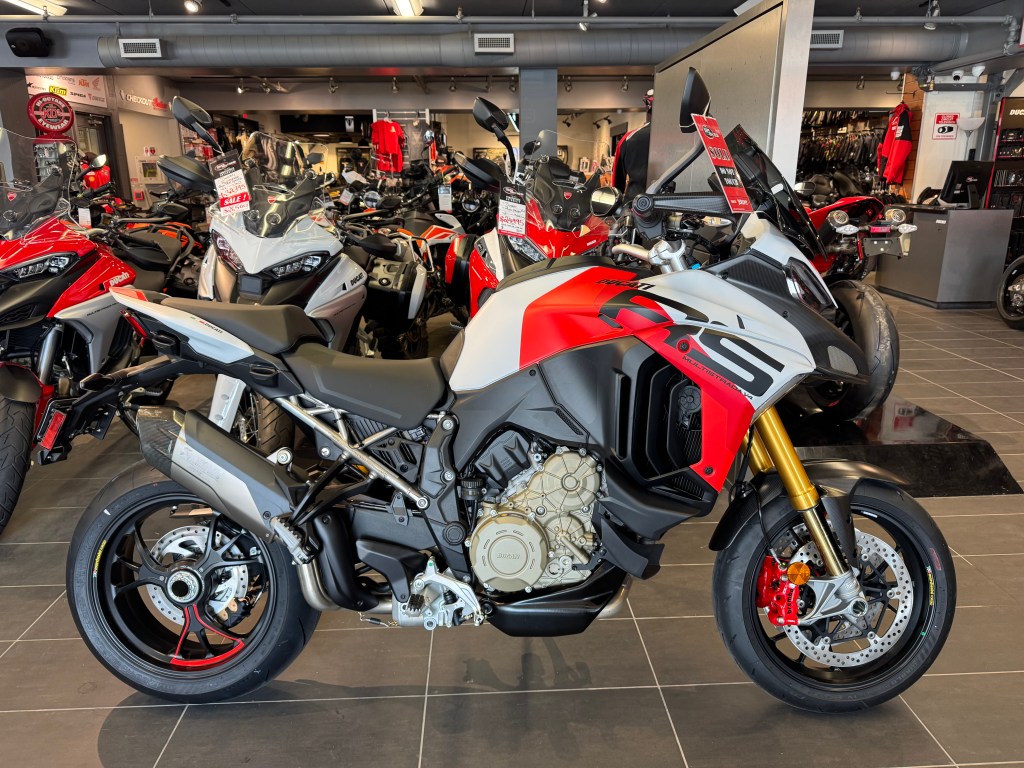
In essence, the 1260 Pikes Peak is the last “analog” Multi. Not that the bike doesn’t feature interesting technology (because it does) but compared to the V4 Multis, it’s like a calculator comparing itself to a laptop. Whether that’s a good or a bad thing is subjective. The 1260 has your usual array of ride modes, ABS, traction control and wheelie control. Some variations (such as the Multistrada S) feature Showa’s first-generation electronic Skyhook suspension, whereas the Pike’s Peak opts for analog Ohlins dampers front and rear, providing lots of flexibility but requiring tools and a bit of know-how.
The V4 Multis take a “technology first” approach to nearly every component of the motorcyle, beginning with the introduction of blindspot monitoring as well as radar cruise control (yes, just like your Audi Q5 has). Suspension is electronic on all but the very base model and the evolution of Ducati’s software adds more parameters around ride modes, throttle response, ABS, wheelie control, traction control, engine braking management…and the list goes on. There’s an array of Bluetooth connectivity features that now include on-screen navigation, control of you music, phone, etc. On some models, the engine de-activates the 2 rear cylinders at low speeds and when stopped in order to reduce heat and conserve fuel. The electronics are impressive but you may want to look at that extended warranty because well…sensors.
Which One Should You Buy?
While we’d usually cut right to the chase and tell you what we think, the current range of models and capabilities (if we limit ourselves to the 1200/1260 and V4 model years) is nothing short of astonishing. Instead, we’ve dumbed it down to a list of pros and cons to help you make the right decision.
| Family | Pros | Cons |
| 1200/1260 V Twins | -Endless V Twin midrange torque -Best Price/Value -Less sensors/top shelf analog suspension (Pikes Peak model) | -Low RPM lumpiness -Ride-by-wire feels a little dated compared to newer models -Shorter service intervals compared to V4s |
| V4s | -Smoothness of V4 at any RPM -Sporty enough for most (even with 19″ front wheel) -Feels like a luxury SUV with all the tech and creature comforts -LONG service intervals | -Heavier, compared to 1200/1260 variants -Long term reliability with all those sensors -Some vibrations in handlebars (not present in V twins) |
| V4 Pikes Peak/V4 RS | -Confidence inspiring suspension shines on a bike this tall (Ohlins Smart EC2) -Exotic enough to convert sportbike veterans -Looks expensive | -Long term reliability with all those sensors -Needs to be ridden fast in order to reach its potential (esp. RS) -Is expensive |
 Chance Moto
Leave a comment